
Introduction
Visual technology has come a long way, and the history of its evolution is a captivating journey filled with ingenious innovations. From the humble beginnings of shadow play to the high-definition screens of today, visual technology has profoundly impacted our lives. In this article, we’ll embark on a voyage through time to explore the remarkable history of visual technology.
The Dawn of Visual Technology
Our journey begins in ancient times, where early civilizations experimented with the art of visuals.
1. Shadow Play (Ancient Times)
Imagine sitting around a fire at night and watching the storyteller’s hands create intricate shadow puppets on a cave wall. This was the birth of visual technology. Early humans discovered that light could be harnessed to form simple, moving images, laying the foundation for the visual technology we know today.
2. Magic Lanterns (17th Century)
Fast forward to the 17th century, and the magic lantern became the first device designed to project images. It used a light source, lens, and glass slides to create large, detailed visuals in dark rooms. Magic lantern shows were popular entertainment of the time.
3. Photography (19th Century)
The 19th century brought us photography. In 1826, Joseph Nicéphore Niépce captured the first photograph. Later, Louis Daguerre improved the process, giving birth to the daguerreotype. This was the start of the visual capture revolution, where moments could be preserved in still images.
The Age of Motion
As we moved into the 20th century, technology accelerated, bringing us moving images and colour.
4. Film and Cinematography (Late 19th to Early 20th Century)
The Lumière brothers presented the first public screening of films in 1895, setting the stage for the movie industry. Film projectors brought stories to life on the big screen, captivating audiences worldwide. In the 1930s, colour film was introduced, adding a new dimension to storytelling.
5. Television (20th Century)
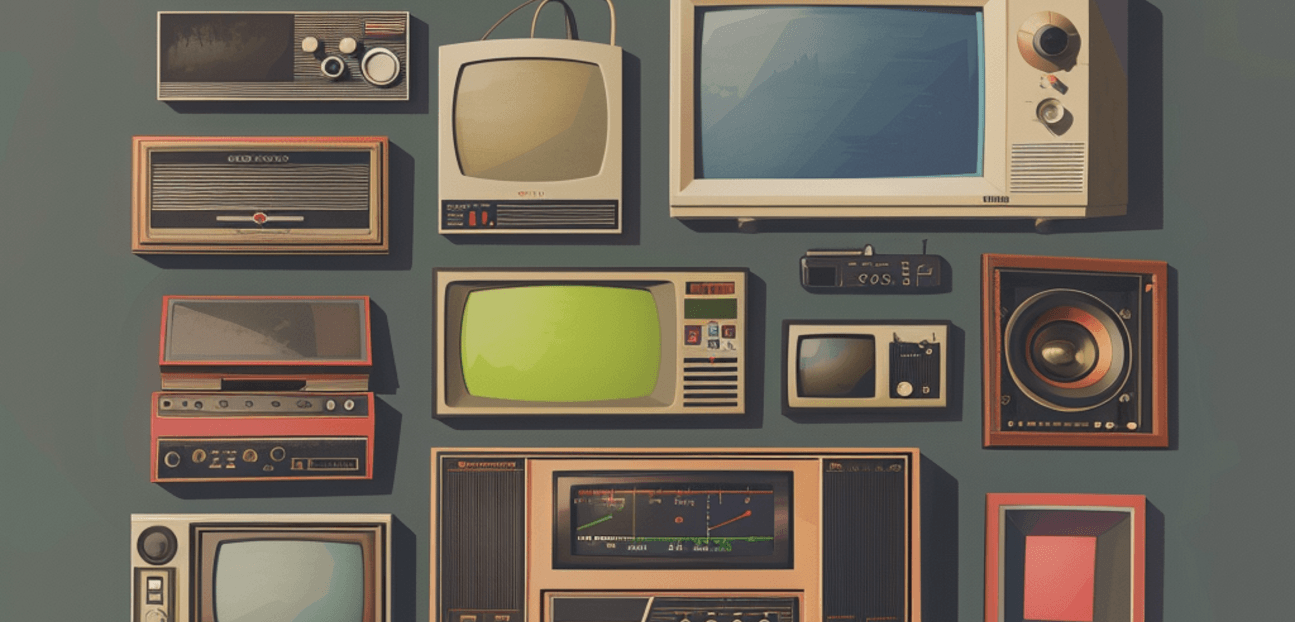
Television, often simply called TV, made its debut in the 20th century. TV sets, like the iconic black-and-white boxes, evolved into colour screens, and the cathode-ray tube (CRT) became a household fixture. Television changed the way we consumed information and entertainment, bringing the world into our living rooms.
The Digital Revolution
The latter part of the 20th century and the 21st century saw an explosion in digital technology.
6. Digital Cameras (Late 20th Century)
The late 20th century saw the rise of digital cameras, making it possible to capture, store, and share photos in a digital format. Film photography started to give way to the convenience of pixels and screens.
7. High-Definition and 4K Displays (21st Century)
The 21st century introduced high-definition (HD) and 4K displays, offering stunning clarity and detail. These screens transformed how we watched movies and TV, and they became an integral part of gaming and digital media.
8. Smartphones and Beyond (21st Century)
Today, we carry powerful visual technology in our pockets with smartphones. These devices have not only revolutionized communication but also turned us into creators and consumers of visual content like never before.
Conclusion
The history of visual technology is a testament to human ingenuity and the drive to bring our visual fantasies to life. From the simple flickering of shadows on a cave wall to the dazzling 4K screens of the present day, it’s been an incredible journey.
As we look ahead, the future of visual technology is bound to bring more astonishing advancements. Whether it’s the immersive experiences of virtual reality, holographic displays, or yet-to-be-imagined innovations, the story of visual technology is far from over. It continues to shape the way we see the world and how we share our experiences with each other. So, the next time you take a picture with your smartphone or sit down to watch a movie on a high-definition screen, you’re participating in a history that spans millennia, a history that’s continually evolving.
How do I begin the process?
You can start your enquiry in a variety of ways. You can fill out the form on our website, contact us via the email address and phone number in the contact us section or messaging us on our social media profiles.
How long does the process take?
We will work to your timeframes, whether your project is currently on site or still years away, we will work with you to build a timeline to match your specific needs.
How much does a custom installation job cost?
Costs for custom installation jobs vary depending on factors such as your budget and specific requirements. Rest assured, we prioritize transparency and will guide you through the costs, presenting different options tailored to your needs and budget.
I don’t know much about AV, is this a problem?
Not at all! Our team is dedicated to guiding you through your options and explaining how they work. We’re committed to helping everyone, regardless of their technical knowledge, achieve their goals and dreams in the audiovisual realm.
Will you install the technology?
Yes, our team of expert, friendly engineers will come out to your project to ensure that all the kit is installed properly, with both aesthetics and technical advantages in mind.
What happens if there is a problem?
Certain solutions can be assessed and have problems fixed remotely, for situations where that isn’t possible where are available via phone or e-mail to offer solutions or send an engineer out to look at the fault.
Do you offer maintenance services?
Yes, we offer maintenance services to keep your system in optimal condition. This may include regular inspections, cleaning, and firmware updates to ensure peak performance and longevity.
How secure are your systems against cyber threats?
Security is a top priority for us. We employ industry-leading encryption and security protocols to safeguard your system against cyber threats. Additionally, we regularly update our systems to address any emerging vulnerabilities and ensure maximum protection.
What if I want to make changes or upgrades to my system in the future?
We understand that your needs may evolve over time. That’s why we offer scalable solutions that can easily accommodate changes or upgrades. Whether you want to add new features, expand your system, or upgrade to the latest technology, we’re here to help.
Is training provided for using the system?
Yes, we provide comprehensive training to ensure you’re comfortable using your system. Our experts will walk you through the functionality and operation of your system, answering any questions you may have along the way.
What warranties do you offer?
We stand behind the quality of our products and services. Depending on the specific components of your system, warranties may vary. We’ll provide you with detailed information about warranties and coverage at the time of purchase.
What happens if there’s a power outage or technical issue?
In the event of a power outage or technical issue, our system is designed to automatically restore functionality as soon as power is restored, or the issue is resolved. Additionally, our support team is available to assist you with any technical issues or concerns you may have.
What is CCTV monitoring
Modern camera’s have features which can be used to detect when things happen such as someone entering a premises, monitoring companies are able to see when this happens to check what the situation is and alert you and/or the authorities to provide an additional layer of security. This is something we can help you with if it’s something you were looking for.
How many cameras do I need for my property, and where should they be placed?
This varies based on requirements, budget, personal preference and size of the property, we will help you to understand the ideal number of cameras for your situation as well as where to place them for optimal coverage
Can CCTV cameras work at night or in low-light conditions?
Yes, there is a variety of options on how to achieve excellent CCTV coverage even at low light levels
How do I access and view footage from my CCTV system remotely?
There are a variety of solutions, but our most popular solution is an app based system allowing you to monitor all cameras instantly directly from your phone, as well as the ability to see past footage, highlights where the camera picked something up as well as phone notifications when something happens.
How can I integrate audio systems with other home automation devices?
Sound systems can be entirely integrated with your home automation system as well as the ability to have control of this system from your phone
How do I control the volume and source of audio in different areas of my home?
It is as easy as going into your app, choosing which speakers you want to add to the zone, and controlling the volume and music directly from the app
What is smart lighting, and how does it differ from traditional lighting systems?
Smart lighting has a variety of benefits such as dimming, automation, change of colour and more, this allows for much more flexible solutions which are also easier to use and take a room to the next level
Can smart lighting systems be controlled remotely or through voice commands?
Yes, certain lighting control systems work alongside voice control and app-based solutions, as well as home automation systems
How can lighting systems enhance security and ambiance simultaneously
Smart lighting has function as well as form, for example lighting that works alongside CCTV to switch on when a certain area is crossed, this alerts you, acts as a deterrent to an invader and provides enhanced lighting to improve CCTV quality
What is access control, and why is it important for home or business security?
Access control is simply controlling who can access a certain location, every home already has this in the form of a lock and key, but there are ways to make this smarter, easier, and more secure